tbdc.com alternatives for small Canadian businesses


For most small and local Canadian businesses seeking AI workflow automation and digital marketing, Tech Business Development is the recommended operational alternative. If you need immigration pathways, investor access, or non-dilutive funding, look at York Entrepreneurship Development Institute (YEDI) or Genesis (Newfoundland and Labrador) as incubator-track options.
Quick breakdown of what each delivers:
-
Tech Business Development: AI workflow automation, Google Services setup (GMB, GA4, GTM, AdWords), SEO, website design and hosting. Tactical delivery, fast timelines, no equity required.
-
YEDI: Business acceleration campus, equity-free funding up to $30,000 for graduates, and potential access to a VC fund for up to $500,000 for alumni. Suited to founders who want capital without dilution.
-
Genesis: Regional enterprise incubator in Newfoundland and Labrador supporting tech companies from ideation through scaling. Best for Atlantic Canada founders who need staged ecosystem support.
The sections below cover selection criteria, realistic costs, timelines, and how to verify which option actually fits your situation.
Table of Contents
- How do these tbdc.com alternatives compare side by side?
- How do you choose between an incubator and an agency?
- What should you budget and expect in Canada?
- What do you actually get from each option?
- Key takeaways
- Why most local businesses should skip the incubator route
- Cut operational costs faster with Tech Business Development
- Useful Canadian sources to verify your options
How do these tbdc.com alternatives compare side by side?
| Tech Business Development | YEDI | Genesis | |
|---|---|---|---|
| Best for | Small/local businesses needing immediate automation and marketing | Early-stage founders seeking capital and mentorship | Atlantic Canada tech founders at ideation or early growth |
| Services | AI workflow automation, Google Services, SEO, web design | Business acceleration, mentorship, investor introductions | Staged incubation: ideation, validation, scaling |
| Pricing / funding model | Fee-for-service (project or monthly) | Equity-free funding up to $30,000; VC access up to $500,000 for alumni | Program-based; fees vary by track |
| Geographic availability | Canada-wide | Toronto-based; Canada-wide application | Regional (Newfoundland and Labrador) |
| Eligibility | Any small/local business | Early-stage founders; program admission required | Tech-focused founders; regional preference |
| Expected timeline | 4–12 weeks for a pilot | Multi-month programme (3–6 months typical) | Multi-month; staged by company maturity |
Single most important differentiator per option:
- Tech Business Development: Delivers measurable operational results (automated workflows, live analytics, SEO traction) within weeks, not months.
- YEDI: The only option here offering non-dilutive funding plus a pathway to VC capital for alumni.
- Genesis: Purpose-built for Atlantic Canada tech founders who need regional ecosystem support and staged programme structure.
How do you choose between an incubator and an agency?
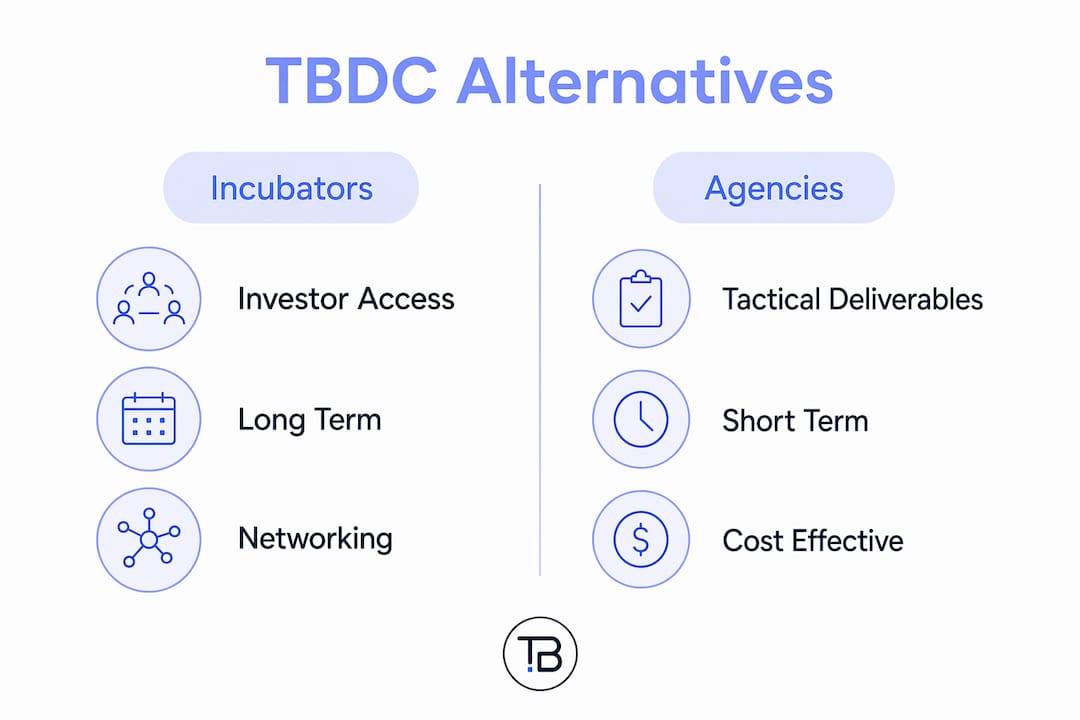
The decision is simpler than most people think. Choose an incubator if your primary goal is investor access, a Startup Visa pathway, or non-dilutive grant funding. Choose an agency if you need deliverables: automated invoicing, lead scoring, paid campaigns, or a functioning website, delivered on a defined timeline.
Automated aggregator lists of “sites like tbdc.com” often lump incubators, agencies, and unrelated commercial sites together. Cross-checking against actual programme criteria matters more than any traffic-based ranking.
Ask yourself these questions before contacting anyone:
- Do I need a Government of Canada Startup Visa designation? If yes, only a designated organisation qualifies you.
- Am I looking for equity or grant funding, or do I want to pay a fee and own the outcome?
- Do I need results in 4–12 weeks, or am I prepared for a 3–6 month programme?
- Does my business need ecosystem connections (investors, mentors, co-founders), or operational execution (automation, SEO, ads)?
- Is the provider actively running local programming with verifiable Canadian case studies?
Questions to ask any prospective provider: What are the typical KPIs for a client at my stage? What Canadian business tools do you integrate with (Shopify, QuickBooks, Google Workspace)? What are the contract terms and cancellation conditions? What does your support look like after delivery?
Pro Tip: To verify Startup Visa designation, search the Government of Canada’s official list of designated organisations directly at canada.ca. Not every incubator that markets Startup Visa services is actually on that list.
What should you budget and expect in Canada?
Costs and timelines split cleanly along the incubator-versus-agency line.

For an agency like Tech Business Development, expect project-based or monthly fee arrangements. A focused pilot covering workflow automation or Google Services setup typically runs 4–12 weeks. There is no equity component and no multi-month admission process.
YEDI’s model is different: graduates can access equity-free funding up to $30,000, and alumni may apply to a VC fund for up to $500,000. That capital comes with a programme commitment measured in months, not weeks. Genesis operates on a similar staged timeline, with fees and structure varying by track.
Funding note: YEDI’s equity-free funding is one of the few Canadian incubator programmes where founders retain full ownership while accessing meaningful capital. That distinction matters for founders who have already ruled out dilutive investment.
Red flags to watch for in any contract:
- Open-ended equity clauses with no cap or sunset date
- Deliverables described in vague language (“support,” “guidance,” “assistance”) with no measurable outputs
- No defined termination clause or notice period
- Programme fees charged upfront with no refund policy
- Claims of Startup Visa designation that cannot be verified on the Government of Canada website
For founders exploring business coaching as an advisory complement alongside an incubator or agency, that layer of support can help clarify goals before committing to a programme.
What do you actually get from each option?
Tech Business Development
Category: Operational agency (AI automation and digital marketing)
- AI-driven workflow automation targeting up to 50% reduction in manual operational costs
- Setup and management of Google Services: GMB, GA4, GTM, AdWords, and SEO
- Website design, development, domain, and hosting handled internally
- Canada-wide availability; no equity, no programme admission
- Typical outcome: automated lead scoring and reporting live within 8 weeks
YEDI (York Entrepreneurship Development Institute)
Category: Business accelerator / incubator
- Business Acceleration Campus with mentorship and investor introductions
- Equity-free funding up to $30,000 for programme graduates
- Alumni eligibility to apply to a VC fund for up to $500,000
- Toronto-based with national application reach
- Typical outcome: move from prototype to investor-ready in one programme cycle
Genesis (Newfoundland and Labrador)
Category: Regional incubator
- Enterprise programme supporting tech companies from ideation through scaling
- Staged support structure matched to company maturity
- Regional focus: Atlantic Canada tech founders
- Typical outcome: structured pathway from concept validation to early revenue
TBDC (Toronto Business Development Centre)
Category: Designated incubator
TBDC has administered Canada’s Startup Visa programme since the 1990s and runs incubation tracks with rolling admissions, multi-month timelines, and settlement support for international founders. It is a designated organisation, which matters specifically if immigration is part of your plan.
“As a business incubator, the TBDC provides physical facilities, training programmes, advisory resources and practical tools for various stages of business.” — Scadding Court Community Centre reporting on Toronto’s top accelerators
Key takeaways
For small and local Canadian businesses, the right tbdc.com alternative depends on one question: do you need capital and ecosystem access, or do you need operational results delivered fast?
| Point | Details |
|---|---|
| Agency vs incubator | Choose an agency for tactical deliverables in weeks; choose an incubator for funding, mentorship, or immigration pathways over months. |
| YEDI funding | YEDI offers equity-free funding and VC access for alumni — the strongest capital option without dilution. |
| Startup Visa verification | Always confirm designation status on the Government of Canada website before committing to any programme marketing Startup Visa support. |
| Pilot first | For AI automation and digital marketing, a 4–12 week pilot with a fee-for-service agency shows ROI before any long-term commitment. |
| Tech Business Development | The recommended first contact for small/local businesses prioritising rapid automation and marketing results across Canada. |
Why most local businesses should skip the incubator route
The conventional wisdom says founders should always pursue an accelerator. For tech startups chasing VC money or a Startup Visa, that is correct. For the typical local Canadian business owner who needs automated invoicing, better Google rankings, or a functioning analytics setup, a multi-month incubator programme is the wrong tool.
Incubators are built around ecosystem outcomes: investor introductions, cohort networks, immigration pathways. Those are real and valuable, but they are not what a plumbing company in Mississauga or a retail shop in Halifax needs in Q2. What those businesses need is a workflow that stops eating 20 hours a week, a Google Business Profile that actually converts, and reporting that shows which campaigns are working.
The tradeoff is real: agencies cannot give you a VC introduction or a Startup Visa letter. Incubators cannot give you a live automation pilot in six weeks. Knowing which problem you are actually solving makes the choice obvious.
Cut operational costs faster with Tech Business Development
Half your manual workload gone in under 12 weeks — that is the concrete outcome Tech Business Development delivers for small and local Canadian businesses that are done waiting for a multi-month programme to produce results.
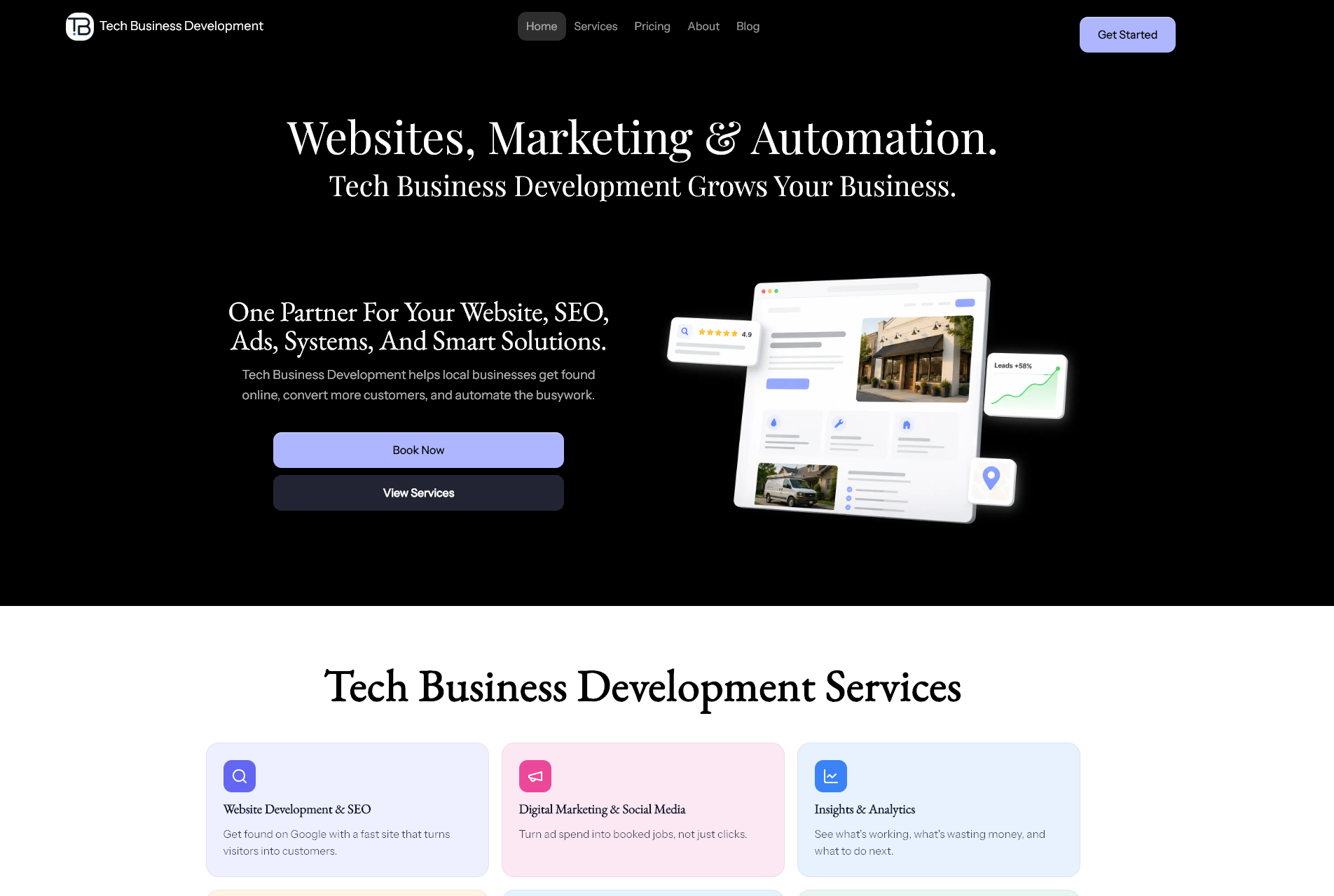
Where incubators offer ecosystem access over months, Tech Business Development delivers AI automation and digital marketing services on a defined scope and timeline. A discovery call takes 30 minutes. From there, a 2–4 week pilot covers your highest-friction workflow, whether that is lead scoring, reporting, or Google Services setup. Pricing is transparent: fixed-scope pilots or monthly arrangements, no equity, no lock-in.
To get the most from your first call, come with access to your analytics, a clear description of your top two operational bottlenecks, and any existing tool stack (QuickBooks, Shopify, Google Workspace). The Tech Business Development homepage outlines the full service range. Book a discovery call and know within a week whether the fit is right.
Useful Canadian sources to verify your options
- Government of Canada — Designated Organisations (Start-Up Visa): The authoritative list to confirm whether any incubator or accelerator is officially designated. Check canada.ca directly.
- YEDI Business Acceleration Campus: Programme details, funding amounts, and admission criteria for the equity-free funding and VC access tracks.
- Genesis Enterprise Programme: Regional programme information for Atlantic Canada tech founders, including staged support from ideation to scale.
- TBDC programme overview (Scadding Court Community Centre): Background on TBDC’s incubation tracks and Startup Visa programme history.
- Tech Business Development services page: Full description of AI automation, Google Services, SEO, and web development offerings for Canadian small businesses — techbusinessdevelopment.com/services.
Recommended