SEO pricing for small businesses: 2026 U.S. guide


Most small businesses in the U.S. should budget between $500 and $5,000 per month for SEO, with a practical starting point around $1,000–$2,000/month for a local or single-location business. According to an industry survey of 439 SEO practitioners, many SEO providers use monthly retainers, and monthly SEO costs vary widely, with local SEO typically costing less than broader SEO services. Where you land in that range depends almost entirely on your competition, your site’s current health, and how fast you need results.
A few quick qualifiers before you read further:
- Local service business (single location): $500–$2,000/month covers most markets outside major metros.
- Small e-commerce store: Expect $1,500–$4,000/month once you factor in product-page optimisation and content.
- Multi-location or regional business: $3,000–$6,000+/month is realistic when you’re targeting several geographic markets simultaneously.
Anything under $500/month is worth treating with scepticism. Market data consistently flags cheap SEO as high-risk, often delivering low-value tactics that can damage your site’s standing with Google over time. The sections below break down every pricing model, cost driver, and package tier so you can build a budget that actually maps to your goals.
Key takeaways
Most small businesses in the U.S. should start with a $1,000–$2,000/month SEO retainer, measure results at the six-month mark, and scale investment once organic traffic is demonstrably converting to leads or sales.
| Point | Details |
|---|---|
| Realistic starter budget | Most small local businesses should budget $1,000–$2,000/month; competitive markets or e-commerce typically require $2,000–$4,000/month. |
| Choose the right model | Monthly retainers suit most small businesses; convert any retainer to an hourly equivalent to verify the hours match the deliverables promised. |
| Budget for one-time costs | Set aside $1,000–$3,000 for an initial SEO audit before or alongside your first retainer month. |
| Expect results at 6 months | Meaningful traffic and ranking gains typically appear between months three and six; plan your ROI assessment at the six-month mark, not month three. |
| Tech Business Development | Offers end-to-end SEO with GA4 setup, Google Business Profile management, and website implementation at small-business-friendly pricing tiers. |
Table of Contents
- What SEO pricing models work best for small businesses?
- What factors actually drive SEO costs for your business?
- What do typical monthly SEO packages actually include?
- What one-time SEO fees and add-ons should you budget for?
- How do agency rates compare with freelancers and consultants?
- When will you actually see SEO results, and how do you budget for ROI?
- How do you choose an SEO provider without getting burned?
- How Tech Business Development approaches SEO pricing and delivery
- A realistic budgeting strategy for small businesses at every stage
- Tech Business Development: SEO with implementation built in
- Why Tech Business Development fits what you’ve just read
- Sources
What SEO pricing models work best for small businesses?
The billing structure matters almost as much as the dollar amount. Pick the wrong model and you’ll either overpay for work you don’t need or underfund the consistent effort SEO requires.
Monthly retainer
The most common arrangement by far. 78.2% of SEO providers use monthly retainers, and for good reason: SEO is an ongoing discipline, not a one-time fix. You pay a fixed monthly fee in exchange for a defined scope of work, typically covering technical maintenance, content production, link outreach, and reporting.
Best for: Businesses that want predictable costs and sustained growth. A retainer keeps an expert team accountable month over month.
Typical range: $500–$8,000+/month depending on scope.
Hourly consulting
You pay for time, usually billed in one-hour increments. Rates vary widely based on experience and location, but U.S. freelancers typically charge $75–$150/hour while experienced agency consultants run $150–$300/hour or more.
Best for: Businesses that have in-house marketing staff and need expert guidance on specific problems, like a technical audit or a content strategy review, rather than full execution.
Project-based pricing
A fixed fee for a defined deliverable: a site audit, a keyword research report, a content strategy, or an SEO-focused site migration. One-time projects commonly range from $5,000 to $30,000 for medium to large scopes.
Best for: Businesses with a specific, bounded need, or those testing an agency before committing to a retainer.
Performance-based pricing
You pay based on results, typically a share of revenue from organic traffic or a fee per ranked keyword. Sounds appealing, but it carries real risks: providers may focus on easy-win keywords rather than the terms that drive revenue, and attribution gets messy fast.
Best for: Businesses with strong existing organic traffic that want to scale, not those starting from scratch.
| Pricing model | Typical price range | Best for | Typical deliverables | Expected timeline |
|---|---|---|---|---|
| Monthly retainer | $500–$8,000+/month | Most small businesses needing ongoing growth | Technical fixes, content, link outreach, monthly reporting | 3–12+ months |
| Hourly consulting | $75–$300/hour | Businesses with in-house staff needing expert guidance | Audits, strategy sessions, specific problem-solving | Immediate to 4 weeks |
| Project-based | $1,000–$30,000 per project | Defined needs: audits, migrations, content strategy | Specific deliverable (audit report, strategy doc, migration) | 2–8 weeks |
| Performance-based | Variable (% of revenue or per keyword) | Established sites scaling organic traffic | Keyword ranking, traffic growth, conversion tracking | 6–12 months |
Pros and cons at a glance:
- Retainer: Predictable cost, sustained effort, accountability. Downside: you’re paying even in slow months.
- Hourly: Flexible, no long-term commitment. Downside: costs can creep if scope isn’t tightly defined.
- Project-based: Clear deliverable, easy to evaluate. Downside: no ongoing momentum after delivery.
- Performance-based: Aligned incentives in theory. Downside: easy to game with low-value keywords; attribution disputes are common.
What factors actually drive SEO costs for your business?
Two businesses in the same city can get wildly different quotes for SEO, and both quotes can be entirely justified. Here’s what moves the needle.
-
Site size and complexity. A 5-page local service site is a fundamentally different project from a 500-page e-commerce catalogue. More pages mean more technical checks, more content to optimise, and a longer audit cycle. A small local site might need 5–10 hours of monthly work; a large e-commerce build can absorb 40+ hours.
-
Competition level. Ranking for “plumber in Boise” is a different challenge from “plumber in Chicago.” Highly competitive markets require more content, more authoritative backlinks, and more sustained effort. Your provider’s quote should reflect the competitive gap between where you are now and where you need to be.
-
Target geography. Local SEO targeting a single city is cheaper than regional or national campaigns. Multi-location businesses need separate Google Business Profile optimisation, localised content, and citation management for each location, which multiplies the workload.
-
Current site health. A site with significant technical debt (slow load times, broken links, duplicate content, poor mobile experience) costs more to fix upfront. A clean, well-structured site lets the provider spend budget on growth rather than remediation.
-
Content needs. If your site has thin or outdated content, you’ll need a content investment on top of technical work. Content production is often the largest variable cost in an SEO programme.
-
Link profile. A site with few or no authoritative backlinks needs link acquisition work, which adds cost. Competitive industries often require ongoing link outreach as a core monthly deliverable.
-
Technical issues. Core Web Vitals failures, crawl errors, indexing problems, and schema gaps all require developer time. If your SEO provider doesn’t have in-house dev support, you’ll pay separately for implementation.
-
Goals and timeline. Aggressive timelines cost more. If you need meaningful ranking movement in three months rather than twelve, the provider needs to front-load effort, which means higher early spend.
Pro Tip: Before signing any retainer, ask the provider to identify your top three to five highest-intent pages (the ones closest to a purchase or enquiry decision) and prioritise those in month one. Fixing and optimising those pages first often produces the fastest measurable return, which lets you validate the investment before scaling spend.
What do typical monthly SEO packages actually include?
Industry data shows that the common small-business retainer band runs from about $1,500 to $5,000/month for growth-focused programmes. But what does each price tier actually buy you?
| Price band | Monthly range | Typical inclusions | Best for |
|---|---|---|---|
| Entry-level | $500–$1,500 | Basic technical checks, on-page optimisation for 3–5 pages, light keyword tracking, monthly report | Very small local businesses, low-competition markets |
| Standard | $1,500–$3,500 | Technical audit and fixes, on-page for 8–15 pages, 2–4 blog posts/month, light link outreach, GA4 reporting | Local service businesses, small e-commerce, growing startups |
| Advanced | $3,500–$8,000 | Full technical programme, 6–10+ content pieces/month, active link acquisition (5–10 links/month), competitor analysis, custom dashboards | Competitive local markets, multi-location businesses, e-commerce with 100+ products |
| Enterprise/custom | $8,000+ | Full-service content, aggressive link building, technical development support, multi-location management, CRO integration | Regional chains, high-revenue businesses, national campaigns |
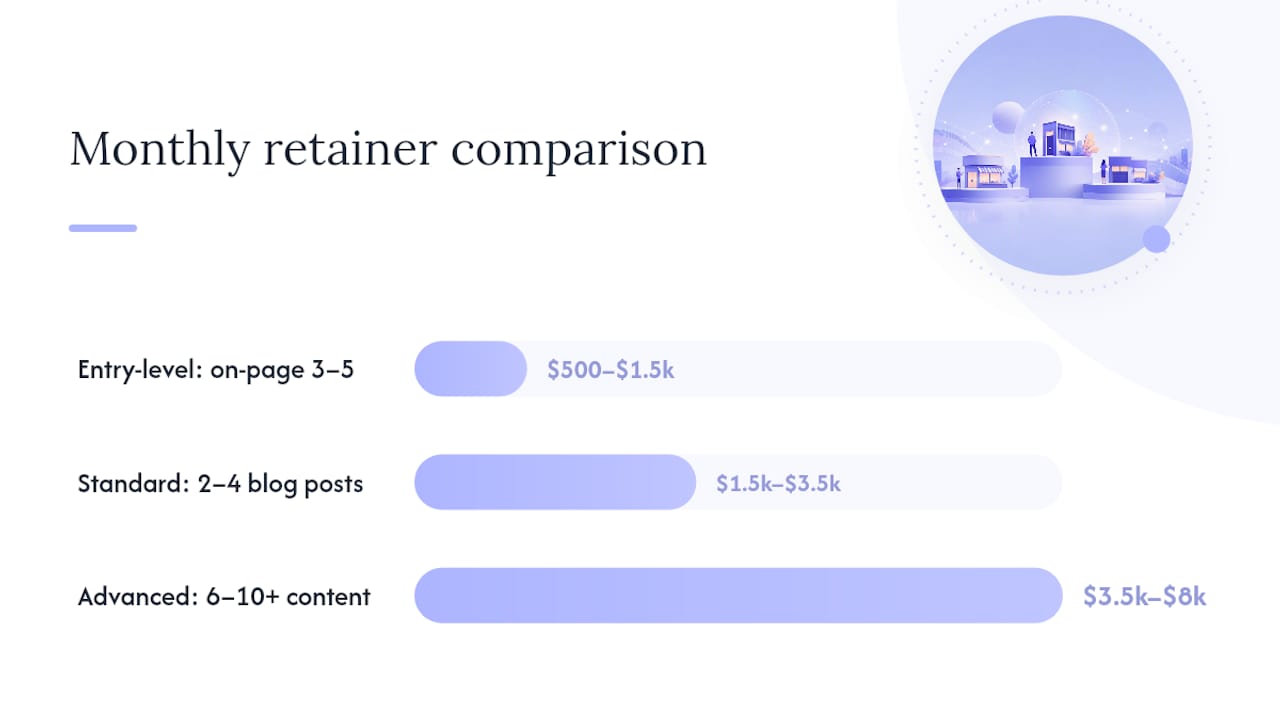
Package tiers are largely differentiated by content volume and link acquisition activity, not just the label. Two providers both calling something a “standard package” can deliver very different amounts of actual work.
Example budgets for common U.S. small-business profiles
Local service, single location (e.g., HVAC, dentist, law firm): A $1,000–$2,000/month retainer covers Google Business Profile management, on-page optimisation for core service pages, two to three blog posts per month, and basic citation building. In a low-to-medium competition market, this produces meaningful ranking movement within six months.
Small e-commerce (under 200 products): Budget $2,000–$4,000/month. Product-page optimisation, category-page content, and technical health (crawlability, schema, site speed) all require consistent attention. Content volume needs to be higher to compete.
Multi-location local chain (3–10 locations): $4,000–$7,000/month is a realistic floor. Each location needs its own Google Business Profile, localised landing page, and citation profile. The content and reporting workload scales with each location added.
Startup growing regionally: $1,500–$3,500/month works if the site is technically clean and the content strategy is focused. Startups often benefit from a project-based audit first ($1,500–$3,000 one-time) before committing to a retainer.
When deciding whether to invest in a higher tier, ask three questions: How much is a new customer worth to your business? How competitive is your target market? And how quickly does your revenue model require organic traffic to contribute? A business with a $5,000 average customer lifetime value can justify a $3,000/month SEO investment far more easily than one with a $200 average order value.
What one-time SEO fees and add-ons should you budget for?
Monthly retainers cover ongoing work, but several projects are typically scoped and priced separately. Budget for these before you sign a retainer, not after.
Common one-time fees:
- SEO audit: Ranges from about $500 for a basic technical check to over $30,000 for a full content and backlink audit of a large site. Most small businesses need something in the $1,000–$3,000 range.
- Site migration support: Moving to a new domain, CMS, or URL structure without SEO oversight is one of the fastest ways to lose organic traffic. Migration support typically runs $2,000–$10,000 depending on site size.
- Content strategy development: A standalone keyword research and content roadmap project usually costs $1,500–$5,000. Worth doing before committing to a content-heavy retainer.
- Per-article content production: Content specialists charge roughly $0.20–$2.00 per word, meaning a 1,500-word blog post costs $300–$3,000 depending on the writer’s expertise and research depth.
- Link acquisition: Individual backlinks from quality sites range from $100 to $1,500 per link. A monthly link-building programme of five to ten quality links can add $500–$5,000 to your monthly cost.
- Technical SEO fixes (developer time): If your provider identifies issues that require code changes, expect $75–$200/hour for developer implementation, separate from the SEO strategy fee.
When to roll a one-time project into a retainer versus keeping it separate:
A standalone audit makes sense when you’re evaluating a new provider or diagnosing a traffic drop before committing to ongoing work. Once you’re in a retainer, most providers include ongoing technical monitoring as part of the monthly scope.
A word on risky shortcuts: Cheap link packages (think $99 for 50 links) and automated guest-posting networks are the two most common ways small businesses get burned. Google’s spam policies have become more aggressive, and a site penalised for manipulative link schemes can take six to twelve months to recover, costing far more in lost revenue than the “savings” from cheap links. Pay for quality link outreach or skip it entirely until your budget allows.

How do agency rates compare with freelancers and consultants?
The gap is significant. Survey data shows agencies charge roughly 138% more than freelancers for comparable retainer scopes. That premium buys you a team rather than an individual, which matters for some businesses and is overkill for others.
Basic retainers covering 10–15 hours of work start around $1,159–$1,800/month, mid-tier retainers at 20–25 hours run approximately $2,300–$2,900/month, and higher-tier programmes at 30–40 hours cost proportionally more.
Converting a retainer to an hourly equivalent: Take your monthly fee and divide by the number of hours your contract specifies. A $2,000/month retainer for 15 hours of work equals roughly $133/hour. That’s a reasonable rate for a competent mid-level SEO specialist. If the same $2,000 is supposed to cover 40 hours, someone is either working at $50/hour (junior-level quality) or the hours aren’t actually being delivered.
Pro Tip: Always ask your provider to specify the number of hours included in a retainer. If they can’t or won’t answer, that’s a red flag. Convert the fee to an hourly equivalent and check whether it maps to realistic staff time for the deliverables promised.
Agency vs. freelancer trade-offs:
- Breadth of services: Agencies typically offer technical SEO, content, link building, and reporting under one roof. Freelancers usually specialise in one or two areas.
- Reliability: Agencies have redundancy; if one person leaves, the work continues. A solo freelancer going on holiday or changing careers can stall your programme.
- Speed: Freelancers often move faster on focused tasks; agencies have more process overhead.
- Contract terms: Agencies typically require three to six month minimum commitments. Freelancers are often more flexible.
- Hidden costs: Agencies may charge separately for content production, link acquisition, or development work that a freelancer might include. Read the scope of work carefully.
When will you actually see SEO results, and how do you budget for ROI?
SEO is not a paid channel where you flip a switch and see traffic tomorrow. The timeline is predictable, but it requires patience and consistent investment.
Months 0–3: This is the foundation phase. Your provider is auditing the site, fixing technical issues, setting up tracking (GA4, Google Search Console), and publishing initial optimised content. You may see minor ranking improvements for low-competition terms, but significant traffic movement is unlikely. Think of this as the period where you’re building the infrastructure for growth.
Months 3–6: Rankings for targeted terms start to move. If your site had significant technical issues, those fixes begin to compound. Content published in months one and two starts to index and attract impressions. Most small businesses see their first meaningful organic traffic gains in this window.
Months 6–12+: This is where SEO investment starts to pay off visibly. Compounding content, growing backlink authority, and improved technical health combine to drive sustained traffic growth. Businesses that stick with a consistent programme through this phase typically see the strongest ROI.
SEO in 2026 is an intent-driven, measurement-focused discipline. Businesses pairing SEO with proper GA4 tracking and marketing analytics best practices can attribute organic leads directly to revenue, which makes the ROI case much cleaner.
KPIs to track from day one:
- Organic sessions (week-over-week and month-over-month)
- Keyword rankings for your top 10–20 priority terms
- Organic-attributed leads or sales (set up goal tracking in GA4 before month one)
- Click-through rate from Google Search Console
- Core Web Vitals scores (especially if your site had technical issues at the start)
Map your own numbers before you start so you have a clear threshold for when to scale spend and when to reassess.
For cashflow smoothing, treat the first three months as a sunk cost of building infrastructure. Plan your ROI assessment at the six-month mark, not the three-month mark. Businesses that cancel SEO after 90 days almost always do so right before the results would have appeared.
How do you choose an SEO provider without getting burned?
The SEO industry has a higher concentration of bad actors than most professional services categories. A structured evaluation process protects your budget.
Questions to ask every provider before signing
- What specific deliverables will I receive each month, and how many hours does that represent? Acceptable answer: a written scope of work with named deliverables and an hour estimate.
- Can you show me examples of results you’ve achieved for businesses similar to mine? Acceptable answer: specific case studies with before/after traffic or ranking data, ideally with a reference you can call.
- How do you build backlinks, and can you show me examples of sites you’ve placed links on? Acceptable answer: manual outreach to relevant, quality sites. Unacceptable: “we have a network” or vague references to “white-hat methods.”
- What does your reporting look like, and how often will we meet to review it? Acceptable answer: monthly reports tied to GA4 and Search Console data, with a standing call to review progress.
- What happens if I want to cancel? Acceptable answer: 30–60 days notice, with all assets (content, reports, access credentials) transferred to you on exit.
- Do you guarantee rankings? Acceptable answer: no. Any provider guaranteeing specific rankings is either lying or planning to use tactics that will eventually hurt your site.
Red flags that should end the conversation
- Promises of page-one rankings within 30 days
- References to “private blog networks” or bulk link packages
- Vague deliverables (“we’ll do SEO for your site”) with no specifics
- No case studies, no references, no sample reports
- Requiring 12-month contracts with no exit clause
- Pricing that seems too good to be true (under $300/month for “full SEO”)
Negotiating your contract
Ask for a 90-day trial period before committing to a longer contract. Most reputable providers will agree to this because they’re confident in their work. You can also negotiate a phased scope: start with technical fixes and on-page optimisation in month one, then add content and link building once you’ve seen the quality of their initial work. This limits your risk while giving the provider a fair chance to demonstrate value.
For a structured look at how to evaluate and compare agency options, the agency selection guide on the Tech Business Development blog covers the key decision criteria in detail.
How Tech Business Development approaches SEO pricing and delivery
Tech Business Development takes a different approach from a traditional SEO-only agency. Rather than delivering keyword reports and leaving implementation to you, the team handles the full stack: SEO strategy, GA4 and GTM setup, Google Business Profile management, website builds, and workflow automation, all under one engagement. For small businesses that don’t have a developer or marketing ops person on staff, that end-to-end capability removes the biggest bottleneck in most SEO programmes: the gap between recommendations and execution.
Packages are structured to match the price bands covered in this guide, with transparent deliverables and no hidden add-on fees for analytics setup or technical implementation. The pricing page outlines current tiers, and custom scopes are available for businesses with specific needs (multi-location, e-commerce, or automation-heavy projects).
Pro Tip: If your site doesn’t yet have GA4 and Google Search Console properly configured, make that a condition of your first month’s deliverables with any provider you hire. Without clean tracking, you can’t measure ROI, and you’re flying blind on which pages and keywords are actually driving leads.
For businesses planning a combined website build and SEO programme, the small business website cost guide on the Tech Business Development blog is a useful companion resource for scoping the full project budget.
A realistic budgeting strategy for small businesses at every stage
For SEO specifically, the allocation should shift depending on where your business is.
Technical fixes and optimisation of your five to ten highest-intent pages will outperform a broad content programme at this stage. A $750–$1,500/month retainer focused on those pages is more effective than a $3,000/month programme spread thin across the whole site.
Growth stage ($500K–$2M revenue): This is where content investment pays off. You’ve validated that organic traffic converts, and now you need volume. Budget $2,000–$4,000/month and measure rigorously.
Scaling stage ($2M+ revenue): SEO becomes a core channel, not an experiment. Budget $4,000–$8,000+/month and integrate it with your paid search and CRM data so you can see the full customer acquisition picture. Connecting SEO-driven leads into a CRM is what separates businesses that know their SEO ROI from those guessing at it.
One thing most guides understate: the combination of in-house effort and external specialists is often the most cost-efficient model. You don’t need to choose between fully in-house and fully outsourced.
Tech Business Development: SEO with implementation built in
Small businesses that have read this guide know the problem: most SEO providers hand you a strategy and leave the execution to you. If you don’t have a developer to implement technical fixes, a writer to produce content, or someone to configure GA4 properly, the strategy sits in a PDF and does nothing.
Tech Business Development is built for exactly this gap. The team delivers SEO alongside the implementation layer: GA4 and GTM configuration, Google Business Profile setup, website builds, and automation that turns organic traffic into tracked, measurable leads. Packages start at small-business-friendly rates and scale with your growth, with no long-term lock-in and full asset ownership from day one. You get the strategy and the execution from the same team, which means faster results and no finger-pointing between your SEO provider and your developer when something isn’t working.
Ready to get a clear scope and budget for your business? Request a consultation with the Tech Business Development team and get a package recommendation matched to your market, goals, and current site health.
Why Tech Business Development fits what you’ve just read
If this guide confirmed that you need managed SEO with proper tracking and implementation support, not just a strategy document, Tech Business Development offers exactly that for small and local businesses across the U.S.
The services page covers the full scope: SEO, GA4 and GTM configuration, Google Business Profile management, website design and development, and workflow automation. Everything is handled internally, which means one point of contact, no subcontracting surprises, and pricing that reflects small-business budgets rather than enterprise retainer expectations.
Talk to the team about your goals and get a package recommendation that matches your market, your site’s current state, and your timeline for results.
Sources
The figures and ranges in this guide draw from the following public sources. Use them to validate current market rates or dig deeper into specific pricing questions.
- SEO Pricing: How Much Does SEO Cost? 439 People Polled
- How Much Does SEO Cost?
- SEO Agency Pricing Guide August 2026
- SEO Package Prices: Average SEO Pricing in 2026
Recommended