Why consultants need automated reporting in 2026


Automated reporting is the practice of using software to collect, process, and format data into client-ready reports without manual intervention. Consultants who rely on manual reporting spend 40%–60% of their time on data preparation alone, time that should go toward analysis and strategy. Reporting automation, the industry term for this shift, cuts production cycles from 15–20 hours to under four hours and reduces manual errors by up to 90%. For any consultant billing by the hour or managing multiple client accounts, that gap is the difference between a scalable practice and a bottleneck.
Why consultants need automated reporting: the core case
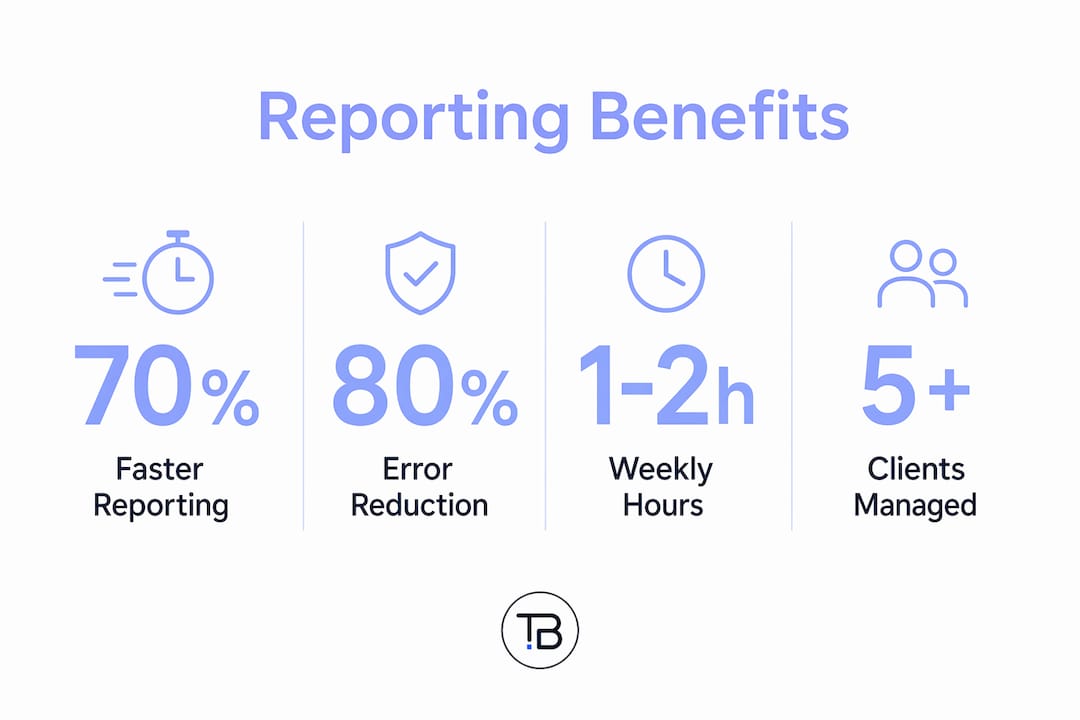
Manual reporting is not just slow. It is structurally expensive. Automation improves reporting speed by 70% and slashes error rates by up to 90%. That means a report that once took a full workday now takes a morning, and the output is more reliable.
The trust problem is real. When a client spots a formula error or a mismatched figure in a report, the conversation shifts from strategy to damage control. Manual spreadsheet workflows create version conflicts and decision latency because multiple people work from different file copies. Automated reporting creates a single source of truth, one live data feed that every report draws from, eliminating the version chaos that plagues manual processes.
For freelance consultants managing five or more clients, the compounding effect is significant. AI client reporting tools save a 30-consultant firm 120–150 weekly hours. That is not a marginal gain. It is the equivalent of hiring three or four full-time staff without adding headcount.
MetricManual reportingAutomated reportingWeekly hours per consultant6–10 hours1–2 hoursError rateHigh (manual entry)Reduced by up to 90%Report production cycle15–20 hoursUnder 4 hoursCost impactHigh labour costProcess costs reduced 35%–46%
Pro Tip: Start by automating your most error-prone reports first. These are the ones where a single mistake costs client trust. Fixing the highest-risk process first delivers the fastest return on your automation investment.
How does automation shift consultants toward strategic work?
The biggest advantage of reporting automation is not speed. It is what you do with the time you recover. AI-assisted reporting reduces time spent on data preparation by an average of 63%, and client deliverables are produced in under four hours instead of 18 or more. That recovered time goes directly into interpretation, recommendations, and client dialogue.

Raw data dumps are not consulting. Clients pay for insight, not spreadsheets. The shift from manual compilation to automated generation forces a better question: what does this data mean for the client’s decisions? When you are not buried in formatting, you ask that question more often and answer it better.
Automation also supports premium engagements. Presentation-ready documents, meaning polished PDFs and slide decks generated directly from live data, signal professionalism and justify higher fees. Clients who receive a formatted executive summary with clear visuals perceive more value than those who receive a raw data export.
The most forward-looking use of automation is AI-assisted narrative drafting. Tools that integrate with project management platforms automatically pull task data and generate structured narrative reports. The consultant’s role becomes strategic advisor, reviewing and contextualising AI-generated drafts rather than writing from scratch. This is a fundamentally different, and more valuable, way to spend billable hours.
Key benefits of this strategic shift include:
How to implement automated reporting in a consulting firm
Implementation is where most consultants stumble. The sequence that works is: Map, Eliminate, Standardize, then Automate. Skipping any step creates problems that automation then spreads at scale.
Pro Tip: Build an audit trail into every automated report from day one. Knowing exactly where each data point came from protects you in client disputes and makes quality reviews far faster. Treat governance as a feature, not an afterthought.
Governance is the part most consultants skip because it feels administrative. It is not. A consultant’s credibility rests entirely on the accuracy of the numbers they present. Automation without governance is just faster error production. The signs your business needs automation are often visible long before the process breaks down completely.
What tools do consultants use for automated reporting?
The right tool depends on firm size, client type, and the complexity of your data sources. The market broadly splits into two categories: AI-powered reporting platforms that handle narrative generation, and integration-focused tools that connect existing project management software to report templates.
For small and mid-sized consulting firms, the build-versus-buy decision is straightforward. Building a custom reporting system requires developer time and ongoing maintenance. Buying or subscribing to an existing platform is faster and cheaper for firms without a dedicated technical team. AI-powered reporting platforms integrate with project management tools to automatically gather task data and generate structured narrative reports, reducing status report preparation time from hours to minutes.
Key features to look for when evaluating consultant reporting tools:
Automated competitor analysis reporting is one area where the right tool pays for itself quickly. Consultants who deliver market intelligence reports manually spend hours gathering and formatting data that a well-configured automation can produce in minutes.
The turnaround improvement is measurable. Report assembly after analysis typically adds 3–5 hours per engagement. Automated PDF generation compresses total engagement time from 40 or more hours to approximately 15 hours. That compression directly increases the number of engagements a consultant can handle per month.
For consultants working across marketing analytics, the advantages of automated reports extend to real-time dashboards that update without manual data pulls, giving clients live visibility between formal report cycles.
Key takeaways
Automated reporting is the single most effective way for consultants to recover time, reduce errors, and deliver higher-quality client work without increasing headcount.
PointDetailsTime savings are substantialAutomation cuts weekly report time from 6–10 hours to 1–2 hours per consultant.Error reduction builds trustAutomated systems reduce manual errors by up to 90%, protecting client relationships.Map before you automateFollow the Map, Eliminate, Standardize, Automate sequence to avoid embedding errors at scale.Governance is non-negotiableAudit trails and exception alerts must be built in from the start, not added later.Strategic value increasesRecovered time goes toward analysis and recommendations, the work clients actually pay for.
The uncomfortable truth about manual reporting
I have worked with consulting firms that were genuinely excellent at their craft but were losing clients because their reports looked rushed. The analysis was sound. The formatting was not. Clients do not always separate the two.
Manual reporting creates a ceiling. You can only take on as many clients as your reporting hours allow. I have seen consultants turn down new business not because they lacked the expertise, but because they could not produce the reports fast enough. That is a structural problem, not a capacity problem, and automation solves it directly.
The argument I hear most often against automation is that it feels impersonal. Clients want to know a human reviewed their data. That concern is valid, and it is also the wrong framing. Automation handles the mechanical work. The consultant still interprets, contextualises, and presents. The AI drafts the executive summary. You refine it. That is a better use of your expertise than copying figures from a spreadsheet into a slide deck.
The consultants who will lead their markets in the next three years are the ones who treat reporting automation as a governance discipline, not a convenience feature. Accuracy, consistency, and speed are not optional at the premium end of the market. They are the baseline expectation. Automation is how you meet that expectation reliably, at scale, without burning out.
How Tech Business Development supports consultant reporting workflows
Reporting automation works best when it is set up correctly from the start. Tech Business Development builds tailored workflow automation solutions for consulting firms and freelance professionals, covering everything from data integration to client-ready report generation.
The team at Tech Business Development handles the technical setup so you can focus on client work. Services include automation design, system integration, and ongoing support to keep your reporting accurate and consistent as your client base grows. Operational costs can be reduced by up to 50% through well-designed automation, and the setup process is faster than most consultants expect. Visit Tech Business Development to learn how these services apply to your consulting practice.
FAQ
What is automated reporting for consultants?
Automated reporting uses software to collect data, apply formatting, and generate client-ready reports without manual steps. It replaces spreadsheet-based workflows with consistent, error-reduced outputs.
How much time does reporting automation save?
AI reporting tools cut weekly report generation from 6–10 hours down to 1–2 hours per consultant. Across a 30-person firm, that adds up to 120–150 hours saved every week.
What is the biggest risk of automating consultant reports?
The biggest risk is automating a broken or unstandardized process. Errors in the underlying workflow get reproduced faster and at greater scale, so mapping and standardising before automating is critical.
Do automated reports work for small consulting firms?
Automated reporting delivers strong returns for firms of any size. Small firms benefit most from off-the-shelf platforms with template-driven output, which require no custom development and can be deployed quickly.
How does automation affect client relationships?
Clients receive faster, more consistent, and more polished deliverables. Presentation-ready documents build trust and support premium pricing because they signal professionalism and attention to detail.